THE FOUR VILLAGES
Hidden in plain sight, guarded by the forest
Four settlements, each shaped by its own corner of a hidden world — a forest, a valley, a mountain, a quiet lane. Every one of them hides the same way: not by chance, but because the land itself chooses who is allowed to find it.
 WALDHEIM
Waldheim
By foot from the forest's outer edge: roughly half a day. By horse: two to three hours.
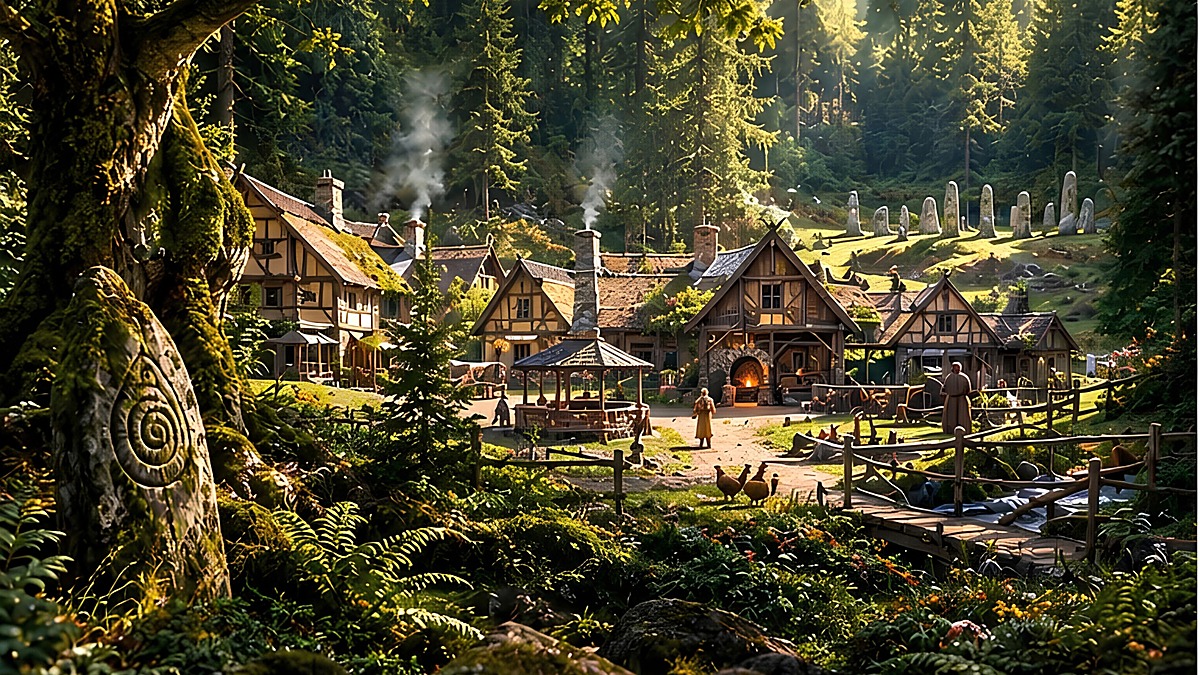
Waldheim sits deep inside a genuine, dense stretch of the Black Forest — not a scattering of trees at the edge of farmland, but proper old-growth forest, thick enough that sunlight reaches the ground only in broken patches. To anyone without the forest's permission to be there, it's the kind of place that swallows sound and sense of direction alike.
For everyone else — a traveller who belongs, a family in genuine need — the forest simply guides them through: a gap in the undergrowth exactly where it's needed, a fallen log bridging a stream, a path unfolding with a rightness rarely questioned. Most visitors never realise the forest has done anything at all.
Once inside, Waldheim itself feels entirely ordinary — cottages built around a well and a council chamber, washing lines strung between houses, chickens underfoot, the smell of baking drifting through the lanes by mid-morning. It is only the forest around it that is extraordinary.
The boundary stones · the village well and council chamber · Wilhelm's forge · the ancient oak at the heart of the village
 MORGENTHAL
Morgenthal
By foot from Waldheim: roughly three weeks by the original route, or four to five days by the faster route established later. By horse: ten to twelve days, or under a day at a hard gallop.
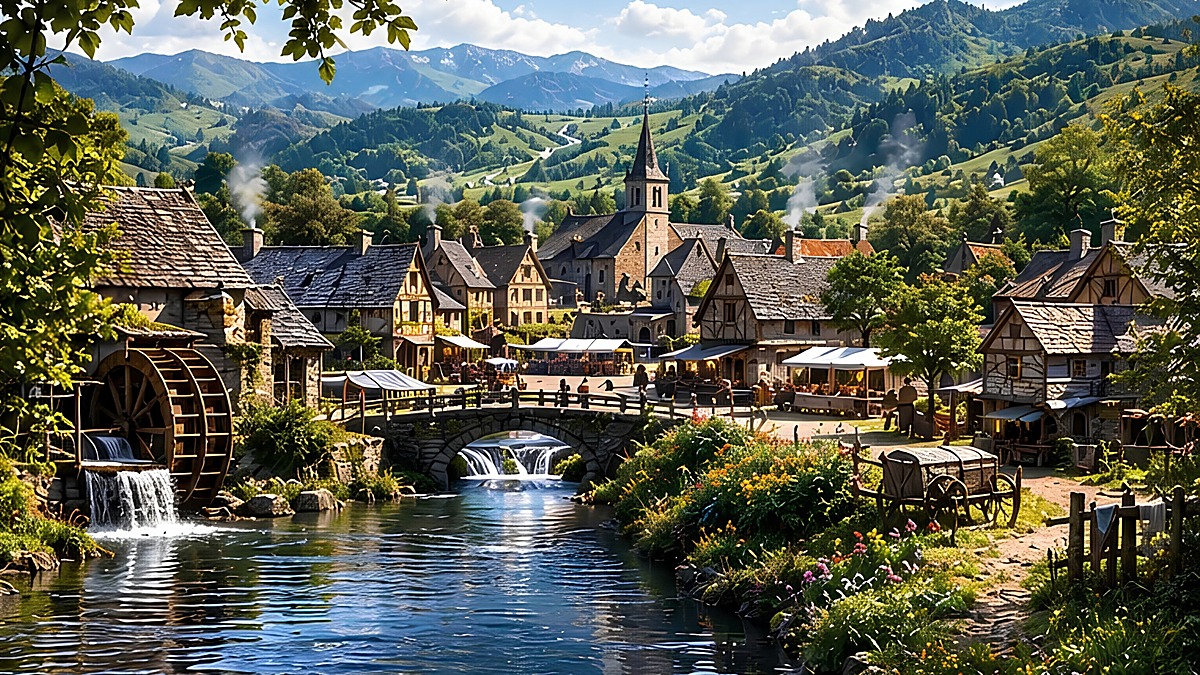
Morgenthal lies east of Waldheim, in a landscape of valleys and rivers rather than dense forest — greener and wetter, with more open sky above the settlement, though the same watchful protection extends over its approach.
Where Waldheim feels tucked into the trees, Morgenthal feels tucked into the land itself, nestled low between two ridgelines with a river passing close enough that its sound carries into the village at night. Its people lean toward the settlement's Miller and Baker lines in daily character as much as bloodline — the village runs on watermills and ovens, and visitors remember it for the smell of the place before anything else: river water, wet stone, and bread.
The river crossing · the central square · watermills and ovens
 FELSENBURG
Felsenburg
By foot from Waldheim: likely most of a day, given the mountain terrain. By horse: several hours at minimum.
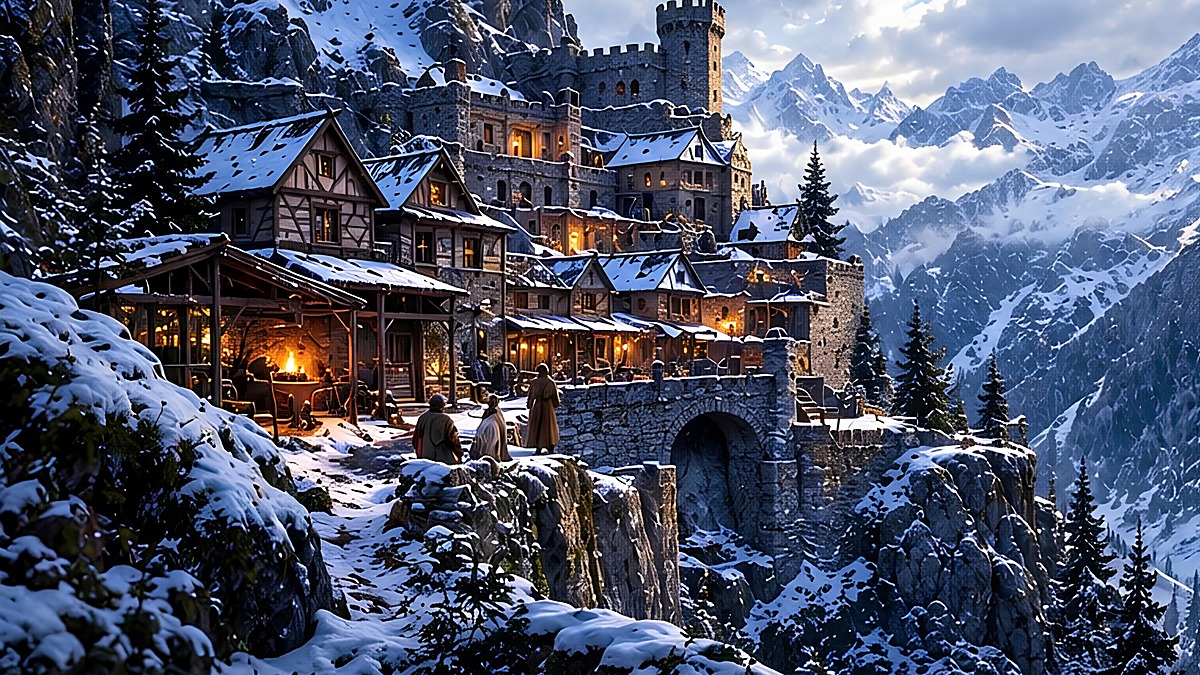
Felsenburg is unlike the other three settlements in almost every visible way — built into the mountains rather than hidden within them, its cottages and halls set against rock and snow rather than timber and leaf-litter. It holds the northern passes, which gives its people a harder, more martial bearing than Waldheim's or Morgenthal's.
Winters come early and stay late. Visitors describe thin air, sudden weather, and a silence in the high passes that feels different from the forest's hush — colder, wider, and somehow more exposed. Despite the harsh setting, Felsenburg is no less a home for its people than Waldheim is for its own: forges working iron pulled from the mountain itself, carpentry built for snow-shedding roofs and reinforced doors, and a weather-sense that makes its people indispensable to anyone planning a journey through the passes.
The northern passes · mountain forges · snow-built halls
 ABENDWALD
Abendwald
By foot from Waldheim: two to three weeks for an ordinary traveller. By horse: roughly three to four days travelling light.
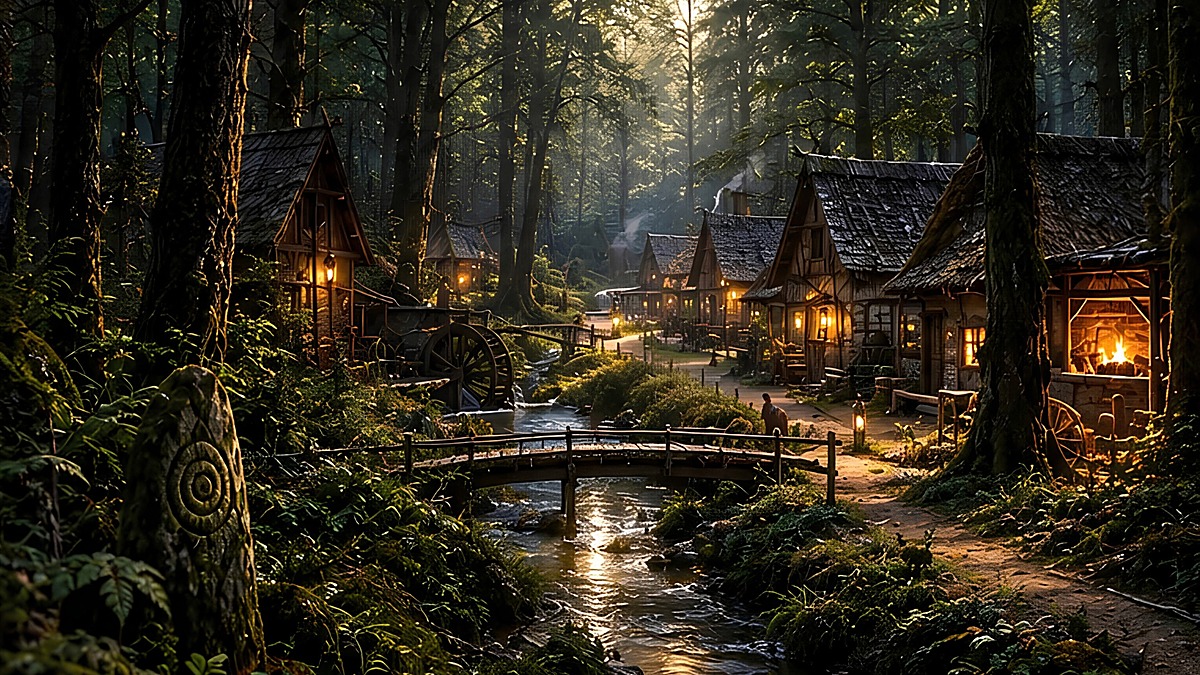
Abendwald sits south-west of Waldheim, in a stretch of forest lower and denser than Waldheim's own, where the trees grow close enough together that daylight reaches the ground only in scattered coins of light. The smallest of the four settlements — no more than a dozen households built along a single winding lane, small enough that everyone knows everyone else by name.
The forest that protects it works, like Waldheim's, by hiding the settlement from anyone it hasn't chosen to let through — though travellers describe it as quieter than Waldheim's: less a sense of being gently guided, more a simple, easy stillness that makes the place hard to think about once you've left it.
The winding lane · a close-knit, single-street village